

 01:10
 snell5coafa4892

Hằng
định nội môi là thuật ngữ căn bản phải nắm rõ dành cho sinh viên y năm 2 bắt đầu
học sinh lý học.
Human homeostasis (homeostasis is from Greek:
ὅμοιος homoios, "similar" and στάσις stasis, "standing still") is the property
of homeostasis within the human body.
The human body manages a multitude of highly complex
interactions to maintain balance or return systems to functioning within a
normal range. These interactions within the body facilitate compensatory changes
supportive of physical and psychological functioning. This process is essential
to the survival of the person and to our species. The liver, the kidneys, and
the brain(hypothalamus, the autonomic nervous system and the endocrine
system[1])
help maintain homeostasis. The liver is responsible for metabolizing toxic
substances and maintainingcarbohydrate metabolism. The kidneys are responsible
for regulating blood water levels, re-absorption of substances into the blood,
maintenance of salt and ion levels in the blood, regulation of blood pH, and
excretion of urea and other wastes.
An inability to maintain homeostasis may lead to death or
a disease, a condition known as homeostatic imbalance. For
instance, heart failure may occur when negative feedback mechanisms become
overwhelmed and destructive positive feedback mechanisms take over.[2] Other
diseases which result from a homeostatic imbalance
include diabetes, dehydration,hypoglycemia, hyperglycemia, gout and any disease
caused by the presence of a toxin in the bloodstream. Medical intervention can
help restore homeostasis and possibly prevent permanent damage to the
organs.
Temperature[edit]
Main article: Human thermoregulation
Humans are warm-blooded, maintaining a near-constant body
temperature. Thermoregulation is an important aspect of human homeostasis. Heat
is mainly produced by the liver and muscle contractions. Humans have been able
to adapt to a great diversity of climates, including hot humid and hot arid.
High temperatures pose serious stresses for the human body, placing it in great
danger of injury or even death. In order to deal with these climatic conditions,
humans have developed physiologic and cultural modes of adaptation.
Temperature may enter a circle of positive feedback, when
temperature reaches extremes of 45°C (113°F), at which cellular proteins
denature, causing the active site in proteins to change, thus causing metabolism
stop and ultimately death.
Energy[edit]
Main article: Energy balance (biology)
Energy balance is the homeostasis of energy in living
systems. It is measured with the following equation:
Energy intake = internal heat produced + external work + storage.
Energy intake = internal heat produced + external work + storage.
When calculating energy balances in the body, energy is
often measured in calories, with the definitions of a calorie falling into two
classes:
- The small calorie or gram calorie (symbol: cal)[3] approximates the energy needed to increase the temperature of 1 gram of water by 1 °C. This is about 4.2 joules.
- The large calorie, kilogram calorie, kilocalorie, dietary calorie or food calorie (symbol: Cal or kcal)[3] approximates the energy needed to increase the temperature of 1 kilogram of water by 1 °C. This is exactly 1,000 small calories or about 4.2 kilojoules.
Blood composition[edit]
Main article: Renal physiology
The balance of many blood solutes belongs to the scope
of renal physiology.
Calcium[edit]
Main article: Calcium metabolism
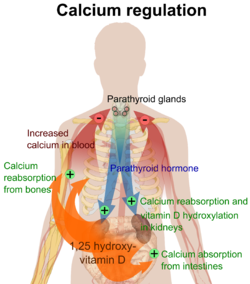
When blood calcium becomes too low, calcium-sensing
receptors in the parathyroid gland become activated. This results in the release
of PTH, which acts to increase blood calcium, e.g. by release
from bones (increasing the activity of bone-degrading cells called osteoclasts).
This hormone also causes calcium to be reabsorbed from urine and the GI
tract. Calcitonin, released from the C cells in the thyroid gland, works the
opposite way, decreasing calcium levels in the blood by causing more calcium to
be fixed in bone.[5]
Iron[edit]
Main article: Human iron metabolism
Iron is an essential element for human beings. The
control of this necessary but potentially toxic substance is an important part
of many aspects of human health and disease. Hematologists have been especially
interested in the system of iron metabolism because iron is essential to red
blood cells. In fact, most of the human body's iron is contained in red blood
cells' hemoglobin, and iron deficiency is the most common cause
ofanemia.
When body levels of iron are too low, then hepcidin in
the duodenal epithelium is decreased. This causes an increase
in ferroportin activity, stimulating iron uptake in the digestive system.
An iron surplus will stimulate the reverse of this process.
In individual cells, an iron deficiency causes responsive
element binding protein (IRE-BP) to bind to iron responsive elements (IRE) on
mRNAs for transferrin receptors, resulting in increased production of
transferrin receptors. These receptors increase binding of transferrin to cells,
and therefore stimulating iron uptake.
Copper[edit]
Many of the components involved in cellular copper
homeostasis are well known at the molecular level. These include transporters
that mediate the uptake and efflux of copper, biomolecules that sequester and
store copper and specialized proteins called copper chaperones that guide copper
to copper-dependent enzymes and to organelles.[6]
Zinc[edit]
Ten proteins of the ZnT family (such as SLC30A1) export
zinc from the cytosol, either out of the cell or into vesicles/organelles,
fourteen proteins of the Zip family (such as SLC38A1) import zinc into the
cytsol from the extracellular space or from vesicles/organelles, and at least a
dozen metallothioneins (MTs) buffer and translocate zinc.[7]
Sugar[edit]
See also: Blood sugar regulation
Blood glucose is regulated with two
hormones, insulin and glucagon, both released from the pancreas.
When blood sugar levels become too high, insulin is
released from the pancreas. Conversely, when blood sugar levels become too low,
glucagon is released. It promotes the release of glycogen, converted back into
glucose. This increases blood sugar levels.
If the pancreas is for any reason unable to produce
enough of these two hormones, diabetes results.
Fats[edit]
See also: Blood lipids
Osmoregulation[edit]
Main article: Osmoregulation
Osmoregulation is the active regulation of the osmotic
pressure of bodily fluids to maintain the homeostasis of the
body's water content; that is it keeps the body's fluids from becoming too
dilute or too concentrated. Osmotic pressure is a measure of the tendency of
water to move into one solution from another by osmosis. The higher the osmotic
pressure of a solution the more water wants to go into the solution.
The kidneys are used to remove excess ions from the
blood, thus affecting the osmotic pressure. These are then expelled
as urine.
Pressure[edit]

See also: Renin-angiotensin system
The renin-angiotensin system (RAS) is a hormone
system that helps regulate long-term blood pressure and extracellular volume in
the body.
Acid-base[edit]
Main article: Acid-base homeostasis
The kidneys maintain acid-base homeostasis by regulating
the pH of the blood plasma. Gains and losses of acid and base must be balanced.
The study of the acid-base reactions in the body is acid base
physiology.
Volume[edit]
Main article: Fluid balance
The body's homeostatic control mechanisms, which maintain
a constant internal environment, ensure that a balance between fluid gain and
fluid loss is maintained. The hormones ADH (Anti-diuretic Hormone, also known as
vasopressin) and Aldosterone play a major role in this.
- If the body is becoming fluid-deficient, there will be an increase in the secretion of these hormones (ADH), causing fluid to be retained by the kidneys and urine output to be reduced.
- Conversely, if fluid levels are excessive, secretion of these hormones (aldosterone) is suppressed, resulting in less retention of fluid by the kidneys and a subsequent increase in the volume of urine produced.
- If there is too much Carbon dioxide(CO2) in the blood, it can cause the blood to become acidic. People respirate heavily not due to low oxygen(O2) content in the blood, but because they have too much CO2.
Hemostasis[edit]
Main article: Hemostasis
Hemostasis is the process whereby bleeding is halted. A
major part of this is coagulation.
Platelet accumulation causes blood clotting in response
to a break or tear in the lining of blood vessels. Unlike the majority of
control mechanisms in human body, the hemostasis utilizes positive feedback, for
the more the clot grows, the more clotting occurs, until the blood stops.
Another example of positive feedback is the release of oxytocin to intensify the
contractions that take place during childbirth.[2]
Sleep[edit]
Sleep timing depends upon a balance between homeostatic
sleep propensity, the need for sleep as a function of the amount of time elapsed
since the last adequate sleep episode, andcircadian rhythms which determine the
ideal timing of a correctly structured and restorative sleep episode.[9]
Extracellular fluid[edit]
Main article: Extracellular fluid
The kidneys, by regulating the blood composition, also
controls the extracellular fluid homeostasis.
The volume of extracellular fluid is maintained by
adjustments made by the kidneys to the osmolality to the blood.
History of discovery[edit]
The conceptual origins of homeostasis reach back to Greek
concepts such as balance, harmony, equilibrium, and steady-state; all believed
to be fundamental attributes of life and health.[10]The
Greek philosopher Heraclitus (540–480 BC) was the first to hypothesize that a
static, unchanged state was not the natural human condition, and the ability to
undergo constant change was intrinsic to all things.[10][11] Thereafter,
the philosopher Empedocles (495-435 BC) postulated the corollary that all matter
consisted of elements and qualities that were in dynamic opposition or alliance
to one another, and that balance or harmony was a necessary condition for the
survival of living organisms. Following these hypotheses, Hippocrates (460-375
BC) compared health to the harmonious balance of the elements, and illness and
disease to the systematic disharmony of these elements.[10][11]
Nearly 150 years ago, Claude Bernard published his
seminal work, stating that the maintenance of the internal environment,
the inner environment, surrounding the body's cells, was essential for the life
of the organism.[12] In
1929, Walter B. Cannon published an extrapolation from Bernard's 1865 work
naming his theory "homeostasis".[10][12][13][13] Cannon
postulated that homeostasis was a process of synchronized adjustments in the
internal environment resulting in the maintenance of specific physiological
variables within defined parameters; and that these precise parameters included
blood pressure, temperature, pH, and others; all with clearly defined "normal"
ranges or steady-states. Cannon further posited that threats to homeostasis
might originate from the external environment (e.g., temperature extremes,
traumatic injury) or the internal environment (e.g., pain, infection), and could
be physical or psychological, as in emotional distress.[12] Cannon's
work outlined that maintenance of this internal physical and psychological
balance, homeostasis, demands an internal network of communication, with sensors
capable of identifying deviations from the acceptable ranges and effectors to
return those deviations back within acceptable limits. Cannon identified these
negative feedback systems and emphasized that, regardless of the nature of the
danger to the maintenance of homeostasis, the response he mapped within the body
would be the same.
References[edit]
- ^ [1] Reference for autonomic and endocrine system.
- ^ a b Marieb, Elaine N. & Hoehn, Katja (2007). Human Anatomy & Physiology (Seventh ed.). San Francisco, CA: Pearson Benjamin Cummings.
- ^ a b Merriam-Webster's Online Dictionary Def 1a http://www.merriam-webster.com/dictionary/calorie
- ^ Page 1094 (The Parathyroid Glands and Vitamin D) in: Walter F., PhD. Boron (2003). Medical Physiology: A Cellular And Molecular Approach. Elsevier/Saunders. p. 1300. ISBN 1-4160-2328-3.
- ^ Brini, Marisa , , , and; Ottolini, Denis; Calì, Tito; Carafoli, Ernesto (2013). "Chapter 4. Calcium in Health and Disease". In Astrid Sigel, Helmut Sigel and Roland K. O. Sigel. Interrelations between Essential Metal Ions and Human Diseases. Metal Ions in Life Sciences 13. Springer. pp. 81–137. doi:10.1007/978-94-007-7500-8_4.
- ^ Scheiber, Ivo; Dringen, Ralf; Mercer, Julian F. B. (2013). "Chapter 11. Copper: Effects of Deficiency and Overload". In Astrid Sigel, Helmut Sigel and Roland K. O. Sigel. Interrelations between Essential Metal Ions and Human Diseases. Metal Ions in Life Sciences 13. Springer. pp. 359–387. doi:10.1007/978-94-007-7500-8_11.
- ^ Maret, Wolfgang (2013). "Chapter 12. Zinc and Human Disease". In Astrid Sigel, Helmut Sigel and Roland K. O. Sigel. Interrelations between Essential Metal Ions and Human Diseases. Metal Ions in Life Sciences 13. Springer. pp. 389–414. doi:10.1007/978-94-007-7500-8_12.
- ^ Page 866-867 (Integration of Salt and Water Balance) and 1059 (The Adrenal Gland) in: Walter F., PhD. Boron (2003). Medical Physiology: A Cellular And Molecular Approaoch. Elsevier/Saunders. p. 1300. ISBN 1-4160-2328-3.
- ^ Wyatt, James K.; Ritz-De
Cecco, Angela; Czeisler, Charlesn nerp A.; Dijk, Derk-Jan (1 October
1999). "Circadian temperature and melatonin rhythms, sleep, and neurobehavioral
function in humans living on a 20-h day". Am J Physiol 277 (4):
R1152–R1163. Fulltext. PMID 10516257.
Retrieved 2007-11-25.
... significant homeostatic and circadian modulation of sleep structure, with the highest sleep efficiency occurring in sleep episodes bracketing the melatonin maximum and core body temperature minimum
- ^ a b c d Moal, ML (2007). "Historical approach and evolution of the stress concept: a personal account". Psychoneuroendocrinology 32: S3–S9. doi:10.1016/j.psyneuen.2007.03.019. PMID 17659843.
- ^ a b Clendening, L (1942). Sourcebook of Medical History. Dover Publications.
- ^ a b c Goldstein, DS; Kopin IJ (2007). "Evolution of concepts of stress". Stress 10 (2): 109–120. doi:10.1080/10253890701288935. PMID 17514579.
- ^ a b Buchman, TG (2002). "The community of the self". Nature 420 (6912): 246–251. doi:10.1038/nature01260. PMID 12432410.
Nguồn: https://en.wikipedia.org/wiki/Human_homeostasis
 Posted in: SINH LÝ HỌC


0 nhận xét:
Đăng nhận xét